
Social Security Retirement Age in 2026: Full Guide and Benefits Chart
Planning for retirement is an important step toward financial security. Understanding the Social Security Retirement Age helps you decide when to stop working, when to claim benefits, and how much money you may receive each month. In 2026, Americans can generally begin collecting retirement benefits at age 62, but claiming early means receiving smaller monthly payments.
The Social Security Administration (SSA) uses your birth year to determine your full retirement age. For people born in 1960 or later, that age is 67. However, waiting until age 70 can increase monthly retirement benefits.
Choosing the right retirement age depends on your health, savings, work history, and financial needs. This guide explains the 2026 retirement rules, benefit amounts, eligibility requirements, and payment calculations to help you understand your options.
What Is the Social Security Retirement Age?
The Social Security retirement age is the age when eligible American workers can begin receiving monthly retirement payments based on their earnings history.
The Social Security Administration manages these payments. Workers generally contribute to the program through payroll taxes during their working years.
Your retirement age affects the amount you receive every month. You can start benefits early, claim them at full retirement age, or delay them for a higher monthly payment.
Understanding Full Retirement Age (FRA)
Full retirement age, also called FRA, is the age when you become eligible to receive 100% of your basic Social Security retirement benefit.
Your FRA depends on your birth year. People born between 1943 and 1954 have a full retirement age of 66. For those born in 1960 or later, it is 67.
Reaching full retirement age does not mean you must stop working. You can continue your job while collecting benefits without being subject to the Social Security retirement earnings test.
Difference Between Early, Full, and Delayed Retirement
Social Security offers different claiming options depending on your age and financial situation.
| Retirement Type | Claiming Age | Effect on Benefits |
|---|---|---|
| Early retirement | Starting at 62 | Permanently reduced monthly benefits |
| Full retirement | 66–67, depending on birth year | 100% of basic retirement benefit |
| Delayed retirement | After FRA through 70 | Higher monthly benefits |
Early retirement provides income sooner, which may help people who cannot continue working.
Full retirement provides the standard monthly amount calculated from your earnings record. Delaying benefits can increase payments for the rest of your life.
Social Security Retirement Age in 2026: Latest Rules
In 2026, Social Security retirement rules continue to allow eligible workers to begin benefits at age 62.
However, receiving full benefits requires reaching the full retirement age set for your birth year.
Several Social Security payment limits and benefit amounts have also changed for 2026 because of annual government adjustments.
What Is the Full Retirement Age in 2026?
For people turning 62 in 2026, the full retirement age is 67 because they were born in 1964.
People born in 1959 have a full retirement age of 66 years and 10 months. Depending on their birth date, they may reach that age during 2025 or 2026.
People born in 1960 and later must reach age 67 to receive their full retirement benefit.
This means the exact full retirement age depends on your birth year rather than one age that applies to everyone.
Has the Social Security Retirement Age Changed in 2026?
There was no new law raising the standard full retirement age during 2026.
The age of 67 for people born in 1960 or later comes from retirement changes passed decades ago.
Although lawmakers continue discussing possible changes to Social Security, proposals to raise the retirement age to 68, 69, or 70 are not the current rule.
The 2026 changes mainly concern benefit payments, earnings limits, work credits, and cost-of-living adjustments.
Important Social Security figures for 2026 include:
| Category | 2026 Amount |
|---|---|
| Cost-of-living adjustment (COLA) | 2.8% |
| Estimated average monthly retired-worker benefit in January | $2,071 |
| Maximum taxable Social Security earnings | $184,500 |
| Earnings needed for one work credit | $1,890 |
| Earnings limit before FRA | $24,480 |
| Earnings limit during the year FRA is reached | $65,160 before reaching FRA |
These figures affect retirement planning, but they do not change the full retirement age based on your birth year.
Why Did the Full Retirement Age Increase From 65 to 67?
When Social Security began paying monthly benefits decades ago, age 65 was the standard retirement age.
Over time, Americans began living longer, and the number of people collecting retirement benefits increased.
Congress passed changes in 1983 that gradually increased the full retirement age from 65 to 67.
Instead of changing the retirement age immediately, the government introduced a gradual schedule based on workers’ birth years.
The goal was to support the long-term finances of the Social Security program while giving workers time to prepare.
Social Security Retirement Age Chart by Birth Year
Your birth year determines when you can receive your full monthly retirement benefit.
The following Social Security retirement age chart shows the full retirement age for different generations.
| Year of Birth | Full Retirement Age |
|---|---|
| 1937 or earlier | 65 |
| 1938 | 65 years, 2 months |
| 1939 | 65 years, 4 months |
| 1940 | 65 years, 6 months |
| 1941 | 65 years, 8 months |
| 1942 | 65 years, 10 months |
| 1943–1954 | 66 |
| 1955 | 66 years, 2 months |
| 1956 | 66 years, 4 months |
| 1957 | 66 years, 6 months |
| 1958 | 66 years, 8 months |
| 1959 | 66 years, 10 months |
| 1960 or later | 67 |
Note: People born on January 1 should generally use the full retirement age for the previous birth year.
Full Retirement Age for People Born Before 1955
People born in 1937 or earlier reached full retirement age at 65.
For those born between 1938 and 1942, the full retirement age gradually increased by two months for each birth year.
People born from 1943 through 1954 have a full retirement age of 66.
Most people in these groups have already passed their full retirement age. However, the information remains useful when reviewing past claiming decisions and retirement records.
Retirement Age for People Born Between 1955 and 1959
People born between 1955 and 1959 have a full retirement age between 66 years and 2 months and 66 years and 10 months.
For example, someone born in 1958 reaches full retirement age at 66 years and 8 months.
Someone born in 1959 reaches full retirement age at 66 years and 10 months.
These workers receive reduced monthly benefits if they start collecting Social Security before reaching their full retirement age.
Full Retirement Age for People Born in 1960 or Later
For anyone born in 1960 or later, the full retirement age is 67.
A person born in 1964 turns 62 in 2026 and can generally begin receiving retirement benefits that year.
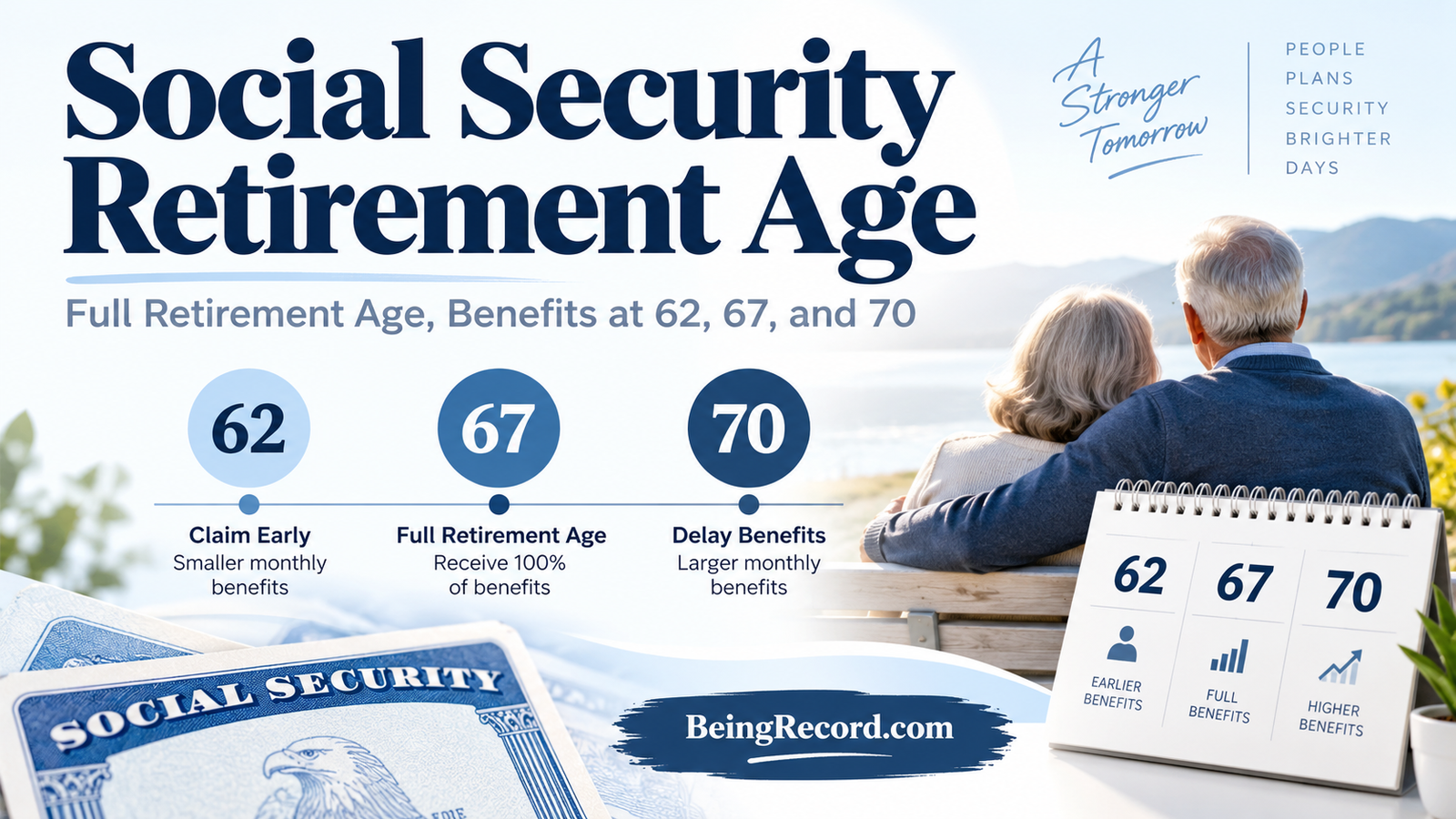
However, claiming at age 62 instead of waiting until 67 can reduce the worker’s monthly retirement benefit by 30%.
Waiting until age 70 can increase the monthly amount to 124% of the benefit payable at 67, before considering later cost-of-living adjustments.
How to Calculate Your Full Retirement Age
Calculating your full retirement age is simple once you know your birth year.
First, identify your year of birth. Next, compare it with the official full retirement age chart.
For example, someone born in July 1962 has a full retirement age of 67 and generally reaches it in July 2029.
A person born in 1959 reaches full retirement age at 66 years and 10 months.
You can also use the SSA retirement age calculator to estimate the age when you qualify for your full monthly benefit.
Can You Collect Social Security Benefits at Age 62?
Yes. Most eligible American workers can begin receiving Social Security retirement benefits at age 62.
However, age 62 is considered early retirement for people whose full retirement age is later.
Claiming early reduces monthly payments because the government expects to pay those benefits over a longer period.
Eligibility Requirements for Early Retirement
To qualify for Social Security retirement benefits, workers generally need at least 40 Social Security work credits.
Most people earn these credits by working and paying Social Security taxes.
In 2026, workers earn one credit for every $1,890 in covered earnings, up to four credits per year.
A person earning at least $7,560 in covered wages during 2026 can receive all four credits for that year.
Most workers who earn four credits each year can qualify after approximately 10 years of covered employment.
However, reaching age 62 and earning enough credits does not guarantee a large retirement payment. The actual benefit depends on your earnings record and claiming age.
How Much Are Benefits Reduced at Age 62?
For people with a full retirement age of 67, claiming at age 62 results in a 30% reduction in their basic monthly retirement benefit.
For example, suppose you qualify for $2,000 per month at full retirement age.
If you begin collecting benefits at 62, your monthly payment would be approximately $1,400 before future COLAs and other adjustments.
This reduction generally continues for life, although later adjustments can affect the payment amount.
A person whose full retirement age is 66 faces a smaller maximum early retirement reduction of 25%.
Advantages and Disadvantages of Claiming Early
Claiming retirement benefits at 62 offers some benefits, especially for people who need money immediately.
Advantages include receiving payments sooner, reducing dependence on savings, and having income available if you stop working early.
However, early retirement also has drawbacks.
Your monthly checks are smaller, your lifetime income may be lower if you live a long life, and early claiming can affect survivor benefits for your spouse.
People who continue working before full retirement age may also face temporary benefit withholding if their wages exceed the annual earnings limit.
Social Security Benefits at Ages 62, 65, 67, and 70
Choosing when to claim Social Security is one of the most important retirement decisions.
Different claiming ages produce different monthly payments, even when the worker has the same earnings history.
The following example assumes a worker has a full retirement age of 67 and qualifies for $2,000 per month at that age.
| Claiming Age | Percentage of FRA Benefit | Example Monthly Benefit |
|---|---|---|
| 62 | 70% | $1,400 |
| 63 | 75% | $1,500 |
| 64 | 80% | $1,600 |
| 65 | 86.7% | About $1,733 |
| 66 | 93.3% | About $1,867 |
| 67 | 100% | $2,000 |
| 68 | 108% | $2,160 |
| 69 | 116% | $2,320 |
| 70 | 124% | $2,480 |
These are simplified examples based on current claiming rules. Actual benefits depend on birth year, earnings history, cost-of-living adjustments, and other factors.
Benefits of Retiring at Age 62
Retiring at 62 allows workers to receive monthly Social Security payments earlier.
This option may help people facing unemployment, declining health, or difficulty continuing full-time work.
However, the 30% payment reduction for workers whose FRA is 67 can make retirement budgeting more difficult.
For someone with a $2,000 full retirement benefit, the reduced payment would be about $1,400 per month.
The main advantage is receiving money sooner. The disadvantage is giving up a higher monthly payment available by waiting.
What Happens if You Claim Benefits at 65?
Age 65 remains an important milestone because most Americans become eligible for Medicare at this age.
However, Medicare eligibility and Social Security full retirement age are not the same.
For someone whose FRA is 67, claiming Social Security at 65 reduces the basic retirement benefit by about 13.3%.
A worker eligible for $2,000 at age 67 would receive approximately $1,733 monthly if they claim at exactly age 65.
This option offers a middle ground between claiming at 62 and waiting until full retirement age.
How Full Retirement Benefits Work at Age 67
For people born in 1960 or later, age 67 is when they can receive 100% of their basic retirement benefit.
If your calculated full retirement benefit is $2,000 monthly, claiming at 67 generally provides that full amount, subject to other adjustments.
You can also continue working after age 67 without facing the Social Security retirement earnings test.
However, reaching full retirement age does not mean your payment is automatically the same as another worker’s payment.
Your earnings history remains the main factor determining your basic benefit.
Also Read: Jude Law
Why Delaying Benefits Until 70 Increases Payments
Social Security rewards eligible workers who delay claiming benefits beyond their full retirement age.
For people born in 1943 or later, delayed retirement credits generally increase benefits by 8% per year after FRA, up to age 70.
A worker whose FRA is 67 can receive 24% more than their full retirement benefit by waiting until 70.
For example, a $2,000 monthly benefit at 67 can increase to approximately $2,480 at 70, before future COLAs.
However, there is no additional delayed retirement credit for waiting beyond age 70.
How Social Security Retirement Age Affects Monthly Benefits
The age when you apply for retirement benefits directly affects how much money you receive every month.
However, age is only one part of the Social Security calculation.
Your lifetime earnings, number of years worked, and claiming date also play important roles.
How the SSA Calculates Retirement Payments
The Social Security Administration generally uses your highest 35 years of covered earnings to calculate retirement benefits.
Past earnings are adjusted using wage-indexing rules, subject to the program’s calculation methods.
The SSA then calculates your average indexed monthly earnings and applies a formula to determine your basic retirement benefit.
This basic payment is called the Primary Insurance Amount, or PIA.
If you worked fewer than 35 years, years without covered earnings may count as zeros in your calculation.
As a result, working additional years can sometimes improve your future monthly benefit.
Early Retirement Benefit Reduction Explained
When you claim Social Security before full retirement age, the SSA reduces your basic monthly benefit.
The reduction is calculated monthly.
For the first 36 months before FRA, the reduction is 5/9 of 1% per month.
For months beyond the first 36, the additional reduction is 5/12 of 1% per month.
This is why someone with an FRA of 67 receives 30% less when claiming at 62.
The reduction is generally permanent, although benefits may be recalculated for certain situations, such as months when benefits were withheld under the earnings test.
Delayed Retirement Credits and Higher Payments
Workers who wait beyond their full retirement age can earn delayed retirement credits.
For those born in 1943 or later, the credit equals 8% per year or approximately two-thirds of 1% per month.
These credits continue accumulating until age 70.
For example, delaying benefits for two full years after an FRA of 67 increases the base benefit by 16%.
Delaying for three full years increases it by 24%.
These increases can provide valuable income later in retirement, especially for people who expect to live many years.
Example of Monthly Benefits at Different Retirement Ages
Consider a worker named Robert who has a full retirement age of 67.
Based on his lifetime earnings, he qualifies for $2,400 monthly at FRA.
His retirement payments could look like this:
| Claiming Age | Estimated Monthly Benefit |
|---|---|
| 62 | $1,680 |
| 65 | $2,080 |
| 67 | $2,400 |
| 68 | $2,592 |
| 69 | $2,784 |
| 70 | $2,976 |
These amounts exclude future COLAs, taxes, Medicare premiums, and changes to his earnings record.
Robert would receive less each month by claiming early, but he would begin collecting money sooner.
By waiting until 70, he would receive larger checks but would have to cover his expenses without those retirement payments during the waiting period.
Maximum Social Security Retirement Benefits in 2026
The maximum Social Security retirement benefit is the highest monthly payment a qualifying worker can receive under specific claiming conditions.
Not everyone receives the maximum amount. It usually requires earning at or near the annual Social Security taxable wage limit for many years.
According to the SSA’s published 2026 examples, the maximum monthly retirement benefits for workers claiming at selected ages are:
| Retirement Age | Maximum Monthly Benefit in 2026 |
|---|---|
| 62 | $2,969 |
| Full retirement age | $4,152 |
| 70 | $5,181 |
These figures describe different people claiming at different ages during 2026. They are not a projection of one person’s benefits as they grow older.
Maximum Monthly Benefits at Age 62
The maximum Social Security retirement benefit for someone claiming at age 62 in 2026 is $2,969 per month under the SSA’s published high-earner example.
Most retired workers receive considerably less because their lifetime earnings were below the annual taxable maximum.
A worker who retires at 62 may also need to cover more years of living expenses.
Before claiming, compare the expected Social Security payment with monthly costs for housing, food, healthcare, and other needs.

Maximum Benefits at Full Retirement Age
The maximum monthly retirement benefit for someone claiming at full retirement age in 2026 is $4,152.
This amount applies to a qualifying worker with a very high earnings record under the SSA’s stated assumptions.
It is not the average retirement benefit.
The estimated average payment for retired workers in January 2026, after the annual cost-of-living adjustment, is approximately $2,071 per month.
This difference shows why workers should review their personal benefit estimates rather than plan around maximum payment figures.
Maximum Monthly Benefits at Age 70
The SSA lists $5,181 as the maximum monthly retirement benefit for a qualifying worker who begins collecting at age 70 in 2026.
This amount reflects a high earnings history and delayed claiming.
Waiting until 70 can increase monthly benefits, but it does not mean every retiree will receive more than $5,000.
Someone with lower lifetime earnings will receive a smaller amount, even when delaying benefits.
The best way to estimate your payment is to review your personal Social Security earnings record.
How Working After Retirement Affects Social Security Benefits
Retirement does not always mean leaving the workforce permanently.
Many Americans choose to continue working part-time or full-time while receiving Social Security payments.
However, your age and employment income can affect your benefits.
Can You Work While Collecting Social Security?
Yes. You can work while receiving Social Security retirement benefits.
If you have already reached full retirement age, your work earnings do not cause benefits to be withheld under the retirement earnings test.
However, workers who collect benefits before FRA may face payment withholding if they earn more than the annual limit.
The SSA mainly considers earnings from employment and self-employment for this test.
Income from pensions, investments, interest, and many other sources generally does not count toward the retirement earnings limit.
Social Security Earnings Limits Before Full Retirement Age
In 2026, the annual earnings limit for people who remain below full retirement age throughout the year is $24,480.
If you earn more than this amount, Social Security generally withholds $1 in benefits for every $2 earned above the limit.
For example, suppose you earn $30,480 while collecting retirement benefits before reaching FRA.
Your earnings exceed the limit by $6,000.
The SSA would generally withhold $3,000 in benefits under the earnings test.
Different rules apply during the year you reach full retirement age.
For 2026, the higher earnings limit is $65,160. Only earnings before the month you reach FRA count toward that limit.
If earnings exceed this higher limit, Social Security generally withholds $1 for every $3 over the limit.
Special monthly rules can also apply during the first year of retirement.
What Happens to Benefits After Reaching Full Retirement Age?
Once you reach full retirement age, the Social Security retirement earnings test no longer applies.
You can earn money through employment without having your retirement payments withheld because of that test.
The SSA also reviews your benefit record when you reach FRA.
If benefits were previously withheld because you worked and exceeded the earnings limit, the SSA may recalculate your payment to account for those months.
This can increase your future monthly benefit.
Continuing to work may also raise your benefit if your new earnings replace a lower-earning year in the 35-year calculation.
However, employment income may increase the amount of Social Security benefits subject to federal income tax.
Social Security Retirement Age vs. Medicare Eligibility Age
Social Security retirement benefits and Medicare serve different purposes.
Social Security provides retirement income, while Medicare helps eligible people pay for healthcare.
Although both programs are important during retirement, their eligibility ages are different.
Why Medicare Eligibility Usually Begins at 65
Most Americans become eligible for Medicare when they turn 65.
This rule generally applies even when their Social Security full retirement age is 67.
Medicare includes different types of coverage.
Medicare Part A mainly covers hospital care, while Part B helps cover doctor visits and other medical services.
Other Medicare options may provide prescription drug coverage or additional health benefits.
People should understand their enrollment dates because late enrollment can sometimes lead to penalties or gaps in coverage.
Can You Receive Medicare Before Social Security Retirement?
Yes. You can enroll in Medicare at 65 without starting Social Security retirement benefits.
For example, a person may begin Medicare at 65 but delay Social Security until age 70.
Certain people with disabilities or qualifying medical conditions can become eligible for Medicare before age 65.
Eligibility depends on the rules that apply to their circumstances.
If you delay Social Security retirement benefits, do not assume Medicare enrollment will happen automatically.
You may need to apply separately.
How to Coordinate Medicare and Retirement Benefits
Retirement planning should include both healthcare coverage and monthly income.
Most people should review Medicare enrollment options around their 65th birthday, even if they plan to keep working.
If you have qualifying health insurance through current employment, you may be able to delay Medicare Part B without a penalty.
However, the rules depend on your coverage and employment situation.
People who contribute to a Health Savings Account should also check how Medicare enrollment affects their ability to make new HSA contributions.
Planning ahead can help prevent unexpected healthcare expenses during retirement.
How Marriage and Family Benefits Affect Retirement Planning
Social Security does not only provide retirement benefits to individual workers.
Eligible spouses, divorced spouses, and surviving family members may also qualify for payments based on another person’s work history.
These benefits can play an important role in household retirement income.
Social Security Spousal Benefits and Retirement Age
A spouse may qualify for Social Security benefits based on their partner’s earnings record.
In many cases, eligible spouses can receive up to 50% of the worker’s basic full retirement benefit.
However, claiming spousal benefits before the spouse’s full retirement age generally reduces the payment.
The worker usually must be receiving retirement or disability benefits before a current spouse can collect spousal benefits on that worker’s record.
Special rules apply to divorced spouses and people caring for qualifying children.
If you qualify for benefits on both your own earnings record and your spouse’s record, Social Security generally does not pay both full amounts together.
Instead, the program applies rules that determine the total benefit you can receive.
Survivor Benefits and Different Eligibility Ages
Survivor benefits provide financial support to eligible family members after a worker dies.
A surviving spouse can generally begin receiving reduced survivor benefits at age 60.
Some surviving spouses with disabilities may qualify as early as age 50.
A surviving spouse caring for a qualifying child may be eligible at a younger age under separate rules.
Survivor benefits also have their own full retirement age rules, which may differ from regular retirement benefits.
The amount depends on factors such as the deceased worker’s benefit, the survivor’s age, and the worker’s claiming history.
These benefits can be especially important for households that depended heavily on one person’s income.

How Claiming Decisions Affect Married Couples
Married couples should consider both partners’ expected benefits before deciding when to claim.
For example, delaying benefits for the spouse with the higher earnings record may increase the income available to the surviving spouse later.
Couples should also compare their savings, ages, health, and monthly expenses.
A household with enough savings may decide to delay one spouse’s benefits while the other spouse receives retirement income earlier.
However, the right decision depends on individual circumstances.
Couples should compare the expected household income from different claiming ages rather than considering each person’s benefit separately.
Factors to Consider Before Choosing Your Retirement Age
Choosing the right retirement age requires more than checking a benefits chart.
Your health, expenses, household income, and retirement goals can all affect your decision.
A claiming age that works well for one person may not be suitable for another.
Health and Life Expectancy
Your health can influence how long you expect to receive retirement benefits.
People with serious health concerns may prefer receiving benefits earlier.
Others who expect to live longer may benefit from waiting for larger monthly payments.
However, predicting life expectancy is difficult.
Family health history, medical needs, and the possibility of living into your 80s or 90s should all be considered.
Personal Savings and Retirement Income
Social Security is only one possible source of retirement income.
Many people also depend on employer pensions, personal savings, retirement accounts, or part-time employment.
Before claiming benefits, estimate your monthly retirement expenses.
These may include housing payments, food, transportation, insurance, healthcare, and emergency costs.
If your savings can support you for several years, delaying Social Security may be easier.
However, people with limited savings may need to begin receiving payments earlier.
Taxes on Social Security Benefits
Some Social Security retirement benefits may be subject to federal income tax.
The amount depends on your filing status and combined income.
For federal tax purposes, combined income generally includes adjusted gross income, tax-exempt interest, and half of Social Security benefits.
The basic income thresholds are:
| Tax Filing Status | Combined Income Threshold |
|---|---|
| Single | $25,000 |
| Married filing jointly | $32,000 |
| Married filing separately | Special rules apply |
If combined income exceeds the applicable limits, some of your Social Security benefits may become taxable.
Depending on your total income, up to 85% of your Social Security benefits may be included in taxable income.
This does not mean the government takes 85% of your retirement payment in taxes.
Instead, it means that portion may be counted when calculating your income tax.
The Impact of Inflation and Cost-of-Living Adjustments
Inflation increases the cost of everyday goods and services.
To help retirement payments keep pace with rising prices, Social Security provides cost-of-living adjustments, commonly called COLAs.
For 2026, the Social Security COLA is 2.8%.
For example, a monthly benefit of $2,000 before a 2.8% adjustment would increase to $2,056, before other deductions or changes.
Actual increases depend on each person’s benefit record and applicable adjustments.
COLAs help protect purchasing power, but retirement expenses can still grow faster than benefits in some years.
Healthcare costs, housing expenses, and household needs should remain part of your long-term financial plan.
How to Apply for Social Security Retirement Benefits
Applying for Social Security retirement benefits is an important step when preparing to leave the workforce.
The Social Security Administration allows eligible people to apply online, by telephone, or through a Social Security office.
Knowing the requirements and preparing your information in advance can make the process easier.
Eligibility and Work Credit Requirements
Most workers need at least 40 Social Security credits to qualify for retirement benefits based on their own earnings.
You can earn a maximum of four credits per year.
In 2026, you receive one credit for every $1,890 in covered earnings, up to the yearly maximum.
Earning 40 credits generally requires about 10 years of covered employment.
However, earning more than 40 credits does not automatically increase your monthly benefit.
Your benefit depends mainly on your lifetime covered earnings and the age when you begin collecting payments.
Some people may also qualify for benefits based on a spouse’s or former spouse’s work record, even without 40 credits of their own.
Documents Required to Apply
Before applying for retirement benefits, gather the information needed to complete your application.
The SSA may request documents or details such as:
- Your Social Security number and date of birth.
- Proof of age or citizenship, when required.
- Bank account information for direct deposit.
- Your recent employment and self-employment details.
- Marriage or divorce information, when applicable.
- Military service records, when relevant.
- Information about previous Social Security applications.
Not every applicant needs to provide all these documents.
The SSA may already have some information in its records and will tell you if additional proof is needed.
Step-by-Step Online Application Process
Applying online is a convenient option for many Americans.
First, visit the official Social Security Administration website and open the retirement benefits application.
Next, follow the instructions to sign in or verify your identity.
Complete the application by providing your personal information, work history, and desired benefit start date.
Review the information carefully before submitting it.
After applying, save your application confirmation and check its status when needed.
The SSA may contact you if it needs more details or supporting documents.
When Should You Apply for Retirement Benefits?
The SSA allows people to apply for retirement benefits up to four months before they want payments to begin.
For example, if you want your benefits to begin in January, you can generally apply as early as September of the previous year.
Applying early gives the SSA time to review your information.
However, your first payment usually arrives in the month after the month for which benefits are due.
You should also remember that Social Security benefits are normally paid electronically.
Choosing a benefit start date requires careful consideration because it affects your monthly payment.
Common Mistakes to Avoid When Claiming Social Security
Some retirement mistakes can reduce your monthly income or create unexpected financial problems.
Understanding the rules before applying can help you make better decisions.
Claiming Benefits Without Comparing Retirement Ages
One common mistake is applying at age 62 without comparing payments at later ages.
Claiming early provides income sooner but may reduce your monthly retirement benefit by as much as 30%.
For someone whose full retirement age is 67, waiting until 70 can provide 24% more than the full retirement benefit.
However, higher monthly payments do not automatically mean higher lifetime payments.
The total amount received depends partly on how long you live.
Comparing several claiming ages can help you choose an option that fits your financial needs.
Confusing Medicare Age With Full Retirement Age
Many people assume Social Security full retirement age is 65 because Medicare usually begins at that age.
However, the two programs use different eligibility rules.
For workers born in 1960 or later, full retirement age is 67.
Medicare eligibility generally begins at 65.
Confusing these ages can lead to unnecessary benefit reductions or missed healthcare enrollment deadlines.
Ignoring Taxes, Earnings Limits, and Spousal Benefits
Another common mistake is focusing only on the monthly Social Security payment.
Taxes, work income, and family benefits can also affect retirement finances.
For example, earning more than the Social Security retirement earnings limit before full retirement age may cause some payments to be withheld.
Retirees with additional income may also owe federal income tax on part of their benefits.
Married couples should review survivor and spousal benefit rules before making claiming decisions.
These factors can change the amount of retirement income available to the household.
Frequently Asked Questions
What Is the Social Security Retirement Age in 2026?
The full retirement age is 67 for workers born in 1960 or later. People born before 1960 may have a lower full retirement age, depending on their birth year.
Eligible workers can generally begin collecting reduced retirement benefits at age 62.
Is Full Retirement Age 67 for Everyone?
No. Full retirement age depends on the year you were born.
People born between 1943 and 1954 have a full retirement age of 66. Those born between 1955 and 1959 have an FRA that gradually increases from 66 years and 2 months to 66 years and 10 months.
For people born in 1960 or later, the full retirement age is 67.
Can I Retire at 62 and Still Receive Social Security?
Yes. Eligible workers can generally begin receiving Social Security retirement benefits at 62.
However, claiming before full retirement age reduces monthly payments.
You should also consider whether your savings and other income sources can support your retirement expenses.
How Much Social Security Will I Lose if I Retire at 62?
If your full retirement age is 67, claiming at 62 reduces your basic monthly retirement benefit by 30%.
For example, someone eligible for $2,000 monthly at 67 would receive approximately $1,400 at age 62, before future adjustments.
The reduction depends on your full retirement age and the exact month you claim.
Is It Better to Take Social Security at 62 or 67?
Neither option is best for everyone.
Claiming at 62 allows you to receive money sooner, while waiting until 67 provides a larger monthly payment for workers whose FRA is 67.
Your savings, health, employment plans, and expected retirement expenses should guide your decision.
What Happens if I Delay Social Security Until Age 70?
If your full retirement age is 67, delaying benefits until 70 increases your basic monthly retirement payment by 24%.
For example, a $2,000 monthly benefit at 67 can increase to about $2,480 at 70, before future cost-of-living adjustments.
No additional delayed retirement credits are earned after age 70.
Can I Collect Social Security and Continue Working?
Yes. You can receive Social Security benefits while continuing to work.
If you are below full retirement age, your benefits may be temporarily withheld when your earnings exceed the annual limit.
After reaching full retirement age, the retirement earnings test no longer applies.
Will the Social Security Retirement Age Increase to 68 or 70?
As of October 2026, the standard full retirement age remains 67 for people born in 1960 or later.
Some policymakers have discussed raising the retirement age to help address the program’s long-term financial challenges.
However, a proposal is not the same as an approved law.
Workers should use the current SSA retirement age schedule when making decisions.
Can I Change My Social Security Claiming Decision After Applying?
In certain situations, yes.
The SSA generally allows a person to withdraw a retirement benefit application within 12 months of first becoming entitled to benefits, subject to rules and approval.
You normally must repay the benefits received, including certain payments made to family members and amounts withheld for taxes or Medicare premiums.
A person can generally withdraw a retirement application only once.
After reaching full retirement age, beneficiaries who have not yet reached 70 may also be able to voluntarily suspend retirement benefits.
Suspending benefits can allow delayed retirement credits to increase future payments, but it may affect benefits paid to family members.
You should understand the rules and possible financial effects before changing your claiming decision.
Additional Retirement Planning Tips for 2026
Planning for retirement requires a long-term approach.
Social Security can provide a reliable source of income, but it may not cover all living expenses.
Understanding the program and preparing early can make retirement more manageable.
Review Your Social Security Earnings Record
Your earnings history plays a major role in calculating monthly retirement benefits.
Mistakes or missing earnings can affect future payments.
Workers should review their Social Security earnings records regularly.
If you notice missing wages or incorrect information, contact the SSA and provide supporting records when available.
Correcting errors before retirement can help protect your future benefits.
Estimate Your Retirement Expenses
Before deciding when to retire, calculate your expected monthly expenses.
Include regular costs such as housing, food, utilities, transportation, healthcare, and insurance.
You should also prepare for unexpected expenses.
For example, home repairs, medical treatments, and family emergencies can increase spending during retirement.
A realistic retirement budget helps you understand how much income you need each month.
Consider Working Longer to Increase Benefits
Continuing to work can improve retirement finances in several ways.
You may earn additional income, increase retirement savings, and delay withdrawals from investment accounts.
Working longer may also improve your Social Security earnings record.
If your new wages replace a lower-earning year among your highest 35 years, your calculated benefit may increase.
However, working longer does not guarantee a higher benefit for everyone.
The result depends on your past earnings, current wages, and claiming decisions.
Understand the Difference Between Retirement Age and Claiming Age
Your retirement age and Social Security claiming age do not have to be the same.
For example, you may stop working at 62 but wait until 67 to begin receiving Social Security.
You may also continue working until 70 while collecting benefits earlier.
Retirement refers to leaving or reducing employment, while claiming refers to starting Social Security payments.
Keeping these decisions separate can give you more flexibility when planning retirement.
Create a Long-Term Retirement Income Plan
A retirement income plan should consider how your money will support you over many years.
Social Security, personal savings, pensions, and investments may all contribute to retirement income.
You should also consider inflation, healthcare expenses, and the possibility of living longer than expected.
A strong plan includes both regular income and funds for unexpected costs.
Reviewing your financial situation each year can help you adjust as your needs change.
Conclusion: Choosing the Right Social Security Retirement Age
Choosing the right Social Security Retirement Age is an important financial decision that can affect your income for the rest of your life. In 2026, eligible Americans can generally start receiving retirement benefits at 62, while full retirement age is 67 for people born in 1960 or later. Delaying benefits until age 70 can provide higher monthly payments.
The best claiming age depends on your health, savings, work plans, family needs, and financial goals. Before applying, compare different benefit amounts, review your earnings history, and consider future expenses. Understanding these rules can help you make a well-informed retirement decision and prepare for greater financial stability.